Nourishing Hope invites you to attend our 7th Annual Fall Fundraiser, Fighting Hunger – Feeding Hope and our first-ever After Party!

Where: The Thompson Chicago, 21 East Bellevue Place, Chicago, IL

When: Friday, October 4, at 6pm with the After Party starting at 9:30pm

Please join us for an elegant evening of cocktails, dinner, fabulous auction items, and a live sale of Nourishing Hope’s operating expenses. Showcasing Chicago’s premiere chefs, including Executive Chefs from the Ballyhoo Hospitality Group and Well Done Hospitality Group. More chefs signing on this week!

Can’t attend the dinner, but don’t want to miss out on all the fun? Join us for our first-ever After Party featuring music, cocktails, & small bites!
9:30pm – Midnight, Featuring: DJ Nurotic, Guest DJ for 103.5 Kiss FM’s Friday Throwback.

Download the full invitation here!


Click to purchase your tickets before we’re sold out!

SNAP benefits rarely disappear overnight. More often, they shrink, run out before the end of the month, or fall short of covering basic needs. Nourishing Hope’s data already shows many households facing reduced or interrupted benefits and they are turning to community food programs to make it through.

Over the past year, Nourishing Hope served +20,000 households. At least 5,000 reported receiving SNAP, though that number is widely believed to be underreported. As federal eligibility rules tighten and benefit windows shorten, far more families may soon feel the impact.

Recent policy changes have added stricter work requirements and limited how long some people can remain enrolled. For individuals who cannot meet those requirements, benefits can end after just three months, with no guarantee of re-enrollment for years.

What the Data Shows

Using Feeding America’s estimated $4.04 cost per meal in Cook County, even small benefit reductions translate into thousands of missed meals, and levels of need that no single organization can absorb alone.

The strain shows up everywhere: at food pantries serving more neighbors, among households living close to the edge, and in the difficult choices families make when money runs out before the month does.

What It Looks Like at the End of the Month

Shameka lives alone. Her child is grown and lives in California. Because her disability income is higher, her SNAP benefit is just $44 a month.

That doesn’t go far. When her SNAP benefit (also called a Link Card in Illinois), and cash run out, Nourishing Hope becomes her safety net.

“Nourishing Hope means a lot to me because when I run out of Link and cash, I can depend on Nourishing Hope to eat at the end of the month.”

For Shameka, food quality and human connection matter too.

“The people are so friendly. The food is so fresh.”

What We Know, and What We’re Preparing For

We know from our data that SNAP losses drive long-term food insecurity. We know from our neighbors that those losses translate into stress, fear, and impossible choices.

While Nourishing Hope cannot close this gap alone, the scale of the challenge means stretching every part of our work, fundraising, partnerships, food sourcing, and service delivery, to meet growing need.

At the same time, we remain committed to protecting what matters most: the quality, consistency, and dignity our neighbors count on.

That is the standard we hold ourselves to, even as demand continues to rise.

For many families, SNAP isn’t just a supplement, it’s the foundation that makes the rest of life possible. New federal rules are reshaping that foundation by expanding work requirements and shortening eligibility for adults without young dependents. These shifts make assistance harder to access and easier to lose, especially for families with teenagers and working adults already stretched thin.

The scale of what’s at stake is enormous. For every one meal provided by Nourishing Hope, SNAP delivers nine. * 

At Nourishing Hope, our data tells part of the story, and our neighbors tell the rest. Together, they reveal how quickly changes to SNAP can ripple through households and increase the need for reliable food support.

Over the past year, Nourishing Hope served more than 20,000 households across our food programs. At least 5,000, roughly one in five, reported receiving SNAP, though that figure is widely believed to be underreported. These numbers help explain why federal SNAP changes intersect so directly with the daily realities of the families we serve.

What the Data Shows

Based on our analysis of households we serve that include teenagers age 14 and older – the group expected to be most affected by recent SNAP changes – 774 families fall into this category. For these households alone, the changes could result in up to 2 million fewer meals each year.

That loss doesn’t happen in isolation. It comes at a time when families are already managing rising food prices, health care costs, housing instability, and, for many, resumed student loan payments.

Our data also shows these same households could lose between $6.3 and $8.4 million annually in SNAP benefits which are grocery dollars families rely on to get through the month. When those resources disappear, the impact is immediate.

What It Looks Like in Real Life

Rose has been coming to Nourishing Hope on and off for nearly a decade. She works part-time cleaning houses and hopes to return to college someday, but right now stability is hard to come by.

“Nourishing Hope means hope,” Rose says. “Without it, I would go crazy with the economy.”

She describes constantly juggling bills, cutting expenses, and trying not to fall behind. Recent SNAP changes have made that balancing act even more frightening.

“Now I’m always looking for ways to cut down expenses. It’s scary to think what to do without this help.”

For Rose, Nourishing Hope is more than food, it’s reliability.

“There has never been a time when I didn’t get food. They always squeeze me in.”

Why This Matters

Our data shows where the pressure will land. Our neighbors show what that pressure feels like.

As SNAP becomes harder to access, families don’t suddenly need less food, they turn to trusted community resources for support. While no single organization can replace federal nutrition programs, Nourishing Hope remains committed to meeting families with urgency, consistency, and dignity.

*Feeding America 

I want to share a story that reflects the resilience of our community and the difference your support makes. It’s the story of Jasmin Robertson, a devoted single mother of four little ones, all under the age of six. 

At just 30 years old, Jasmin carries the weight of the world on her shoulders. Her youngest child, only one year old, has a rare medical disorder and has been in the hospital since birth. Jasmin spends her days learning how to care for him so she can finally bring him home. She is also working two part-time jobs to try to make ends meet.

Recently, Jasmin shared,

“When I have no food for my kids, I have to leave the hospital and come here to stand in line. I’m so grateful to live in a city where we help each other. I love Nourishing Hope the most because you have things I never see in a traditional food bank, like olive oil spray and pink salmon. And people help me out. It feels like I’m in a grocery store, and that makes me happy. People here aren’t just doing their job, I can see they really care. God is good.”

Jasmin’s words remind us what hope truly looks like: a mother’s courage, a community’s compassion, and the power of kindness when the world feels heavy.

Right now, thousands of families across Chicago are facing hardships like never before. With SNAP cuts, the longest-running government shutdown, and the fear of ICE presence in our neighborhoods, far too many parents are struggling to keep their families safe and fed.

In just the past few weeks, we’ve seen a 25% increase in demand at our food pantries — and even higher requests for assistance through our Online Market. To ensure families can sit around the table with an abundant holiday meal, we are purchasing far more food than ever before. 

With heartfelt gratitude,

Mitzi D. Baum, CEO
Nourishing Hope


Here’s Why Our Community Must Act Now

At Nourishing Hope, we meet people every day who are doing everything right but still struggling to put food on the table. Parents working multiple jobs. Older neighbors living on fixed incomes. Families trying to recover from setbacks.
For many, SNAP (the Supplemental Nutrition Assistance Program) is the lifeline that makes groceries possible. It’s the nation’s largest anti-hunger program, serving children, older adults, people with disabilities, and low-wage workers. When SNAP falls short, families turn to us.

And now, SNAP is changing in ways that will leave millions with less — or nothing at all.

What’s Changing

This summer, Congress passed the One Big Beautiful Bill Act (July 2025), which reshaped SNAP overnight:

  • More people must prove they work, train, or volunteer 80 hours every month to keep benefits.
  • Benefits will no longer keep pace with rising food prices.
  • States must shoulder new costs, which could make it harder for people to stay enrolled.

Many of these rules took effect immediately. Families are already being cut off.

And in September, USDA ended the annual Household Food Security Report — the government’s main way of tracking hunger. That means less national accountability and fewer tools to measure just how bad the crisis is becoming.

The Human Impact

What does this mean in real life?

  • Roughly 3 million people each month may lose SNAP benefits.
  • Grocery prices are still rising, especially for staples like meat, eggs, and dairy.
  • Families will turn to food pantries like Nourishing Hope in record numbers.

We already see it: parents skipping meals so their kids can eat, seniors stretching a week’s worth of groceries into two, and neighbors showing up at our doors for the first time ever. These are not statistics — they are our community.

What It Means for Nourishing Hope

These cuts hit us from every angle:

  • More demand: More neighbors need food right now.
  • Higher costs: Every dollar buys less at the grocery store.
  • More support needed: Families need help navigating confusing new SNAP rules.
  • Less national data: With USDA no longer reporting hunger trends, our local tracking and advocacy matter more than ever.

Why Your Support Matters Now

Without SNAP, families will be forced to make impossible choices:

  • Skipping meals.
  • Sending kids to school hungry.
  • Choosing between food, rent, and medicine.

That’s why your support matters more than ever.

  • Give — every dollar helps us stretch meals further.
  • Volunteer — walk alongside families as they face these new rules.
  • Advocate — use your voice to protect food access.

Together, we can bridge the SNAP gap — giving families food for today and hope for tomorrow.

Donor Spotlight: Meet Michele Hoovler

Michele Hoovler didn’t expect to find herself looping grocery bags over her shoulders alongside neighbors at Nourishing Hope’s food pantries. But that hands-on volunteer experience — and the genuine connections she made — has transformed her family’s approach to giving.

“I was really nervous about being able to relate to the clients, about my inability to speak Spanish,” Michele admits about her first volunteer experience. “But I found that everyone was kind. We’d work together in both languages to choose groceries. I was just amazed and really humbled by that.”

What struck her most was witnessing the dignity and resilience of families facing food insecurity. “I see people waiting outside in all types of weather for 3.5 hours before the doors open, because they need to get food,” Michele says.

“I think to myself — if I were trying to feed my family on around 4 lbs. of meat in a month… Well, I don’t know if I could. But our neighbors arrive with a smile, with hope.”

Beyond the human connections, Michele is moved by Nourishing Hope’s efficiency. “I was overwhelmed by the logistics involved,” she says. “To see the trucks, the food, the shelves, and to realize that Nourishing Hope is able to do what it does at that level of financial efficiency — I was very impressed.”

The Hoovler Family Giving Fund’s approach to philanthropy reflects Michele’s practical wisdom:

“If you got an extra five bucks, send the five bucks. I just went to Starbucks and bought myself a $10 drink, so I would like to mentally allocate $10 to something that’s not for me.”

For the Hoovlers, food insecurity became a clear priority. “If you can’t eat, you can’t do anything,” Michele explains. “We’re at a place in our lives where we feel that it’s very important to give back. We can each have at least a little bit of empathy with folks that have a greater need.”

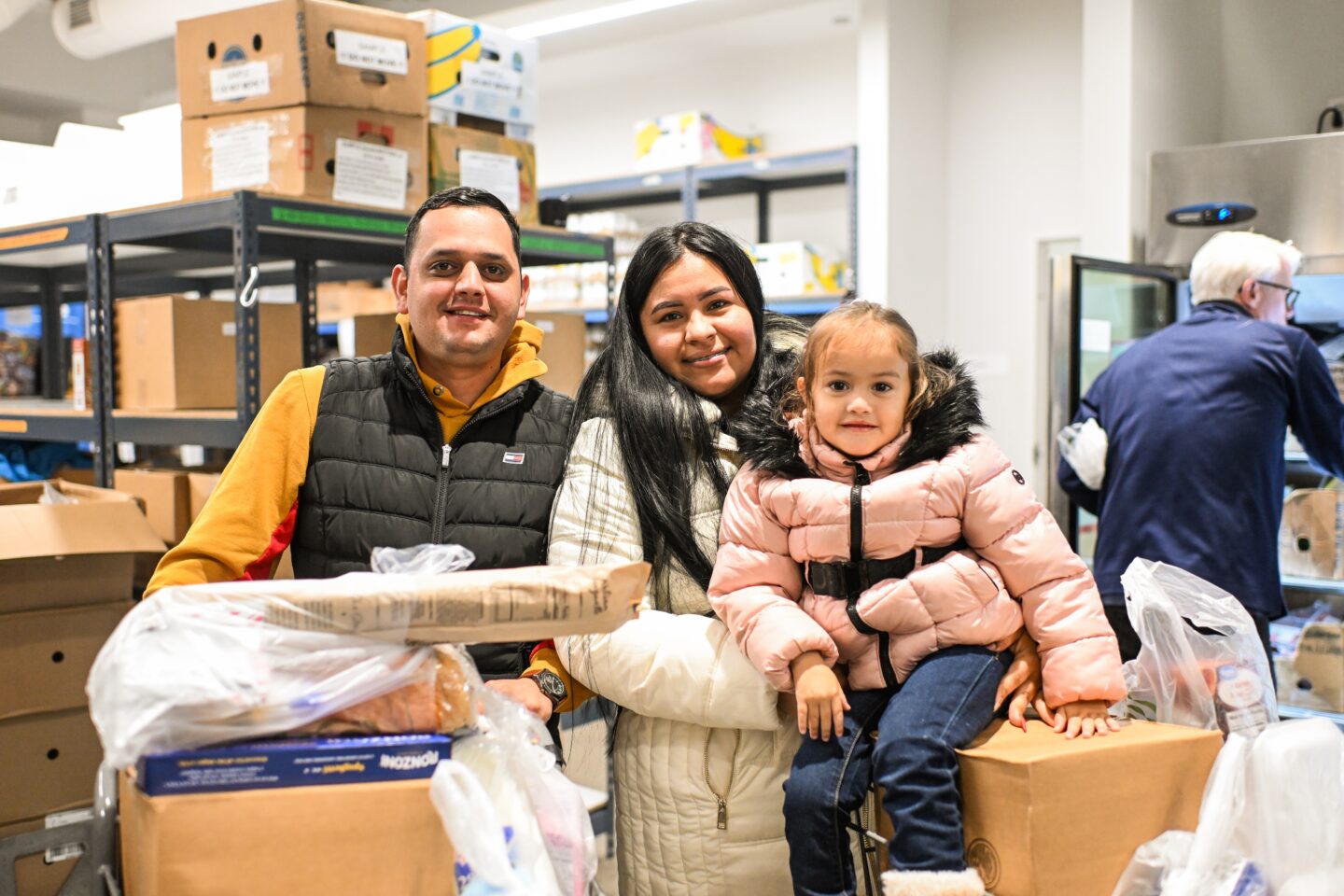
A family with their groceries at Nourishing Hope’s El Mercadito food pantry.

With government funding sources under pressure, Michele sees individual giving as more crucial than ever. She has a simple message to potential donors:

“No matter what, people need to eat. For anyone who’s looking for a place, or anyone who’s feeling a little bit of that tug, ‘Maybe I could give just a little bit more…’ — come visit Nourishing Hope. When I saw it firsthand, I thought, ‘This is it. This is the place.’”

Thanks to The Hoovler Family Giving Fund, all donations up to $50,000 are MATCHED during September for Hunger Action Month. Double your gift today at nourishinghopechi.org/hungeractionmonth

Your gift is MATCHED


In our Summer Impact Report, you’ll read about the latest news from Nourishing Hope — including learning about one of our newest Online Market partnerships with Growing Home in Englewood.

In the first quarter of fiscal year 2026, you helped us serve nearly 24,000 people, which is already 43% towards our estimated number of neighbors for the entire fiscal year. Simply put, more neighbors are seeking support than we expected.

Read the full report to meet donor Michele Hoovler, who has a call to action this Hunger Action Month, “If you have extra, give extra.” Thanks to The Hoovler Family Giving Fund, all donations up to $50,000 are MATCHED during September for Hunger Action Month. Double your gift today at nourishinghopechi.org/hungeractionmonth

Make sure you catch the update on our 2025 #TeamNourishing Hope Marathon runners, see our recent media mentions, snag a promo code from our composting partner, WasteNot (NOURISHINGHOPE), and, of course — secure your tickets for our upcoming annual Nourishing Hope Gala.

Thank you for your dedication to providing food for today and hope for tomorrow.

read the impact report

Published Thursday, August 21

Read the latest from Kaitlin Washburn of the Chicago Sun-Times, featuring an interview with our Interim CEO Mitzi Baum:

Repurposed newsstands will now provide free doses of an overdose reversal drug to the Uptown neighborhood.

The four newsstands are a part of the Chicago Department of Public Health’s ongoing efforts to prevent overdoses in the city. Naloxone, also known by the brand name Narcan, is administered through the nose to reverse the deadly effects of fentanyl and other opioids.

The naloxone is free to take and will be available at all four locations starting Aug. 27.

Mitzi Baum, chief executive for Nourishing Hope, told the Sun-Times offering the naloxone supply outside the organization’s food pantry is a natural extension of the other services it provides. The organization has already been supplying free naloxone and drug testing kits at its three locations in Uptown, Humboldt Park and West Town.

The stand was set up outside Nourishing Hope this week.

“It means a lot to us to be able to provide this support to our neighbors,” Baum said. “It’s lifesaving.”

Read the full article here

Nourishing Hope Names National Nonprofit Leader and Food Safety Advocate Mitzi Baum as Chief Executive Officer

Nourishing Hope is proud to announce the appointment of Mitzi Baum as its new CEO, following a successful term as interim leader during a period of organizational transition. 

Mitzi brings nearly three decades of leadership in the food systems and public health space, having spent 23 years at Feeding America, one of the nation’s largest domestic hunger-relief organizations. Most recently, she served as CEO of Stop Foodborne Illness, a nonprofit focused on protecting public health through food safety advocacy and education. A national expert in food bank logistics, food safety, compliance, and capacity building, Mitzi is known for her servant leadership style, authentic relationship-building, and data-driven approach to achieving measurable outcomes.

Her appointment comes at a critical time for the social services sector. With widespread cuts to SNAP, Medicaid, and USDA programs, community-based organizations like Nourishing Hope are facing unprecedented strain. Under Mitzi’s leadership, the organization is poised to weather these challenges, as well as continue leading with innovation, advocacy, and a deep commitment to ensuring that all Chicago residents can thrive.

“Mitzi brings both strategic vision and a deep compassion for our mission,” said Marc Brenner, Board President of Nourishing Hope. “We are facing serious challenges as a sector, but Mitzi’s experience and commitment equip us to move forward with purpose and strength.”

Since stepping into the interim role in May, Mitzi has provided hands-on leadership at each of Nourishing Hope’s four facilities, working closely with senior staff to strengthen daily operations and align around strategic goals. Her focus on transparency and collaboration has been key to advancing major initiatives and streamlining decision-making processes. Mitzi also fosters a culture of open communication, empowering staff at all levels to actively shape the organization’s future.

Mitzi’s dedication to service and equity — combined with her operational expertise and bold, thoughtful leadership — has already earned the deep trust of both the board and the team. Her leadership will be vital as Nourishing Hope continues to expand its impact in Chicago’s diverse communities.

“I am honored to lead Nourishing Hope during this critical time,” said Baum. “Together, we will meet the moment with heart, focus, and resilience — ensuring that every person we serve has the support and dignity they deserve.”

Pride isn’t just a month. It’s a year-round commitment to showing up with authenticity, compassion and resilience. At a time when access to gender-affirming care is at risk, nonprofits are stepping up to fill in the gaps. This past spring, Nourishing Hope launched its inaugural in-person counseling group for LGBTQIA+ adults, I have a Queer-y. The cohort met for 10 weeks at Nourishing Hope’s Sheridan Market and was facilitated by two queer mental health workers, Abby Mayhue (she/they) and Richard Campos (they/them). 

Both Mayhue and Campos recently completed internships with Nourishing Hope and earned their Master’s degrees in clinical mental health counseling at DePaul University. Mayhue now works as a research associate for the Texas Institute for Excellence in Mental Health at the University of Texas. 

Discussion questions (or “queer-ies”)  for the group focused on labels, boundaries, intersectionality, conflict resolution and queer joy. Mayhue compared the structure of the group to a funnel. Each session would begin with a broad curriculum topic, grow more focused through discussion, before concluding with specific skills practices to aid self-reflection. This process created a safe space for participants to share personal experiences, questions, frustrations and joys.

“I’m really inspired by this element of resilience and of resistance in the queer community,” Mayhue said. “Mental health care is resilience, to me.”

Campos agrees. “The next, however many years, won’t be the easiest. But we’ve done hard things as a community, and we will continue to do hard things together,” they said. 

For queer people, by queer people

There was inherent acceptance and authenticity built into the group, Mayhue explained. “Having a therapy group for queer people — specifically for us and facilitated by us — that, I think, is Pride,” they said.
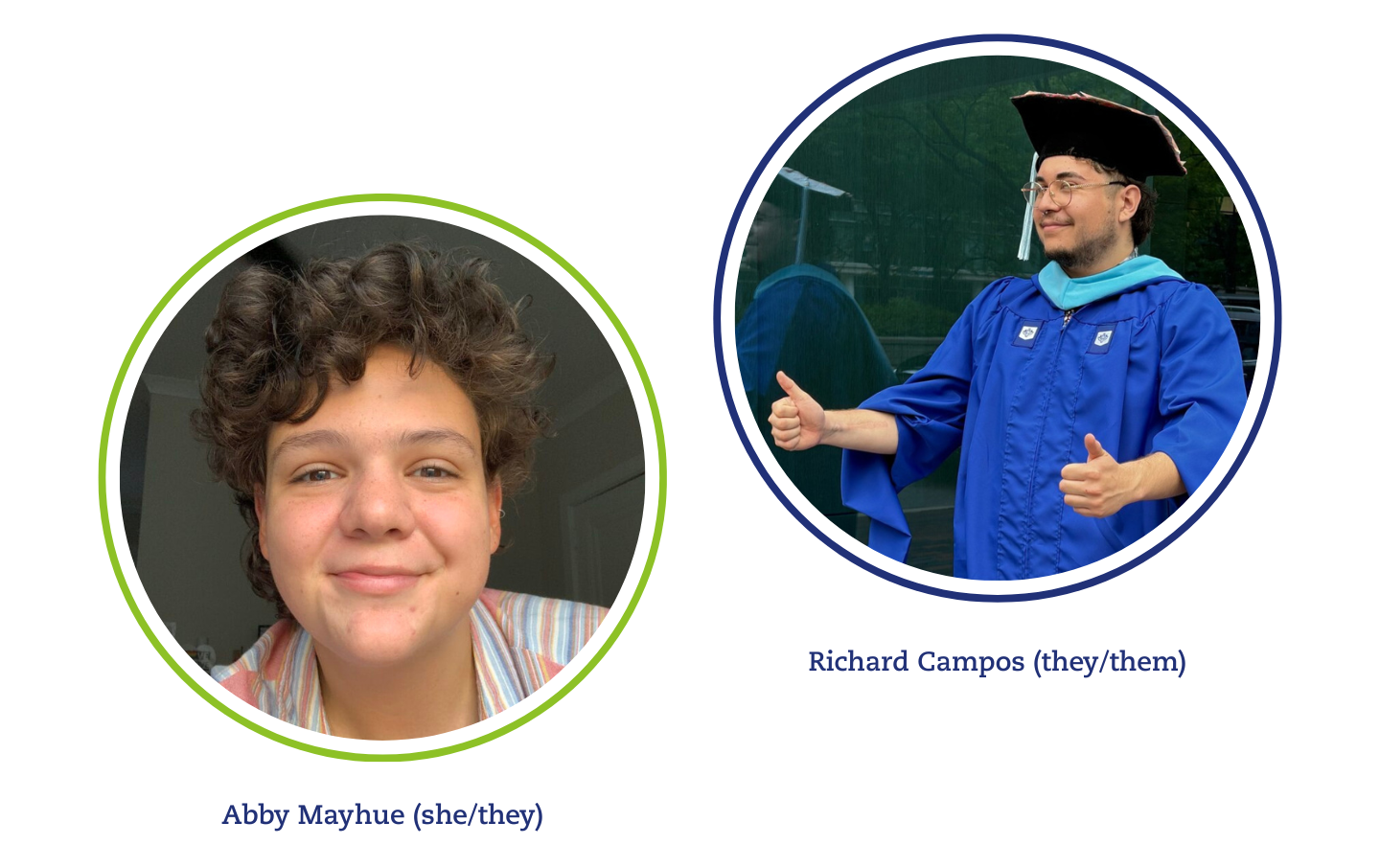
Group facilitators Abby Mayhue and Richard Campos.

As facilitators, Mayhue and Campos balanced their curriculum with open processing and specific skills practices. Each session encouraged autonomy for the participants to share what they would like to explore in upcoming weeks.

“This experience disrupted people’s ideas of what group therapy could be,” said Campos. “We explored how we interact with systems at large, how we interact with others and how we interact with ourselves.” The goal was to create intentional opportunities to reflect on queer identities and encourage community building.

Mayhue was moved by the support they witnessed throughout their mental wellness internship at Nourishing Hope:

“There is power and value in this organization saying, ‘We love our queer neighbors. They are part of our community too. We welcome you. We want to serve you,’” said Mayhue. 

Throughout this past year, Nourishing Hope has held therapy groups for LGBTQIA+ folks, for migrant women, for people experiencing anxiety and depression, and for BIPOC neighbors experiencing grief and loss. These support groups are made possible with generous support from Nourishing Hope’s donors and partners. This June, Nourishing Hope’s annual Pride Month campaign raised more than $85,000 (a new record for the organization) – ensuring future care for neighbors. 

Political and social systems are working to isolate us

Both Mayhue and Campos were inspired by participants’ interests in intersectionality. One neighbor shared that they don’t talk enough about intersectionality with their friends — as many of them share similar labels or identities. Having the opportunity to dive into this topic with the group was significant to them. 

Campos emphasized that it’s important to prime these conversations by honoring people’s differences. “It’s important to have other identities around you, but not to treat them as educators, because that can be very stressful for folks with marginalized identities.” The group discussed allyship, acceptance and biases in order to better show up for the more marginalized groups of the queer community.

Questions the group posed include: How do we advocate for the rights that we deserve? For the rights of others? How do we improve our lives as a community? And, how do we take care of ourselves as individuals?

In asking these questions, another powerful theme emerged for the group: isolation.

“Isolation is a prominent challenge in the queer community right now,” Mayhue explained. “Political and social systems are working to isolate us. Technology can bring us closer together but can also promote isolation,” she said. 

The group discovered a strong desire to overcome isolation and build connection. Mayhue recommends building a routine of intentional reflection, and of seeking others. “Whether you’re helping your friend move, or talking through a conflict, seeking connection is a primary way to boost this element of, ‘I’m not alone in this, and I have my community, and they will support me in this way, as I support myself,'” said Mayhue.

Pride and joy, quite literally

Campos shared that they and Mayhue were initially concerned that the sessions might quickly become inundated with grief or anxieties. But what occurred was just the opposite. 

“We saw folks coming into this space as brave people, who were looking to do this work in community with each other,” Campos said. 

Through discussions on systems, history and queer liberation, participants didn’t solely focus on communal grief. But they did allow it to exist in the same space as reflection, laughter and joy. “The quote by queer writer and activist Dan Savage came up frequently,” Campos added. “He said, ‘During the darkest days of the AIDS crisis, we buried our friends in the morning, we protested in the afternoon and we danced all night.’”

For Campos, Pride means being able to be there for others in the ways that people have been there for you. Nourishing hope for queer people isn’t just a show of support, it’s necessary and potentially life-saving. The modular curriculum that Campos and Mayhue built ensures that future iterations of the group will live on.

“It’s saying I won’t let go of you, because so many people didn’t let go of me. We can exist for each other,” Campos shared. 

Nourishing Hope is committed to serving our LGBTQIA+ neighbors and allies with free mental health services, social services, and emergency food support, year round — full stop. If you or anyone you know is seeking free mental wellness support, fill out the interest form on our website. One of Nourishing Hope’s therapists or mental wellness interns will be in touch soon. Learn more about Nourishing Hope’s internship offerings for graduate students here.
Czarnecki focuses on packing bags of diapers for distribution at Sheridan Market.

For one dedicated volunteer at Nourishing Hope, volunteering is more than simply handing out groceries. It’s treating our neighbors with respect and restoring dignity to their lives.

On a recent summer afternoon, Lynelle Czarnecki worked the Sheridan Market distribution shift. She’s been volunteering with Nourishing Hope for over a year, but her work with food justice began much earlier. 

“My mother ran a food pantry out of our basement,” Czarnecki shared.

Czarnecki was one of dozens of volunteers at Sheridan Market that day. Senior Manager of Pantry Programs Angela Cimarusti-Clifford explained, “We have roughly 40 volunteers a day: two shifts for each distribution, and each shift has about 20 volunteers. In addition to distributing food, unpacking trucks, and re-stocking shelves, volunteers greet neighbors and check them in at each Nourishing Hope distribution.

Sheridan Market, located just steps from the Red Line stop of the same name, serves as more than a place to pick up emergency food services.

“There’s something that a lot of our neighbors like about actually coming into the pantry — I think there’s a sense of community,”  Cimarusti-Clifford added. “Some volunteers and neighbors almost have a friendship.” 

On this particular day, Sheridan Market served 418 people from 223 households. In a traditional month, Sheridan Market serves around 4,000 households, according to Cimarusti-Clifford. 

For thousands of volunteers like Czarnecki, Nourishing Hope is more than just a name — it’s a verb. It’s an action we take when we care for one another.

Bilingual Case Manager Nate Marquez helps neighbors with social services in both Spanish and English.

While sorting donated diapers into bags by size, Czarnecki reflected on the fact that food insecurity is often the foundation of other challenges, such as physical injuries and struggles with mental health. As a retired therapist, Czarnecki approaches neighbors with empathy and understanding when volunteering at Nourishing Hope.

If you think of the word ‘hope,’ it helps people have a more positive mindset.

“You know how when we think about healthcare, we look at things as wellness? I see this as an organization that focuses on wellness,” Czarnecki said. “They are focusing on the essential things like food, but they are also focusing on mental health, focusing on dignity and respect.”

Nourishing Hope aims to provide well-rounded support to our neighbors by addressing not just physical needs, but also mental wellness and social stability. In fiscal year 2025, Nourishing Hope provided 7,040 social services, including assistance with employment, housing, and utilities. This number includes more than 3,400 free, trauma-informed mental health counseling sessions.

The community aspect is something Cimarusti-Clifford emphasized as central to Nourishing Hope’s mission. “Building these relationships with our volunteers, our neighbors, and between volunteers and neighbors, is crucial,” she said.

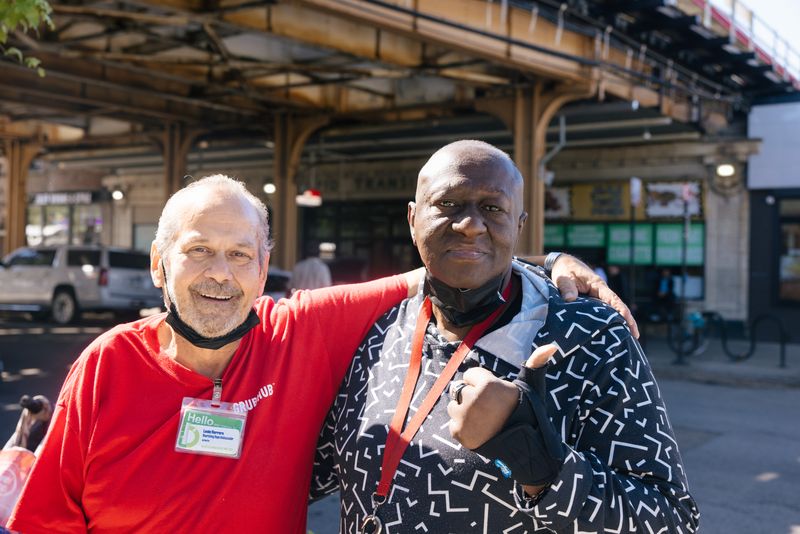
Volunteer Louie Herrera (left) poses outside Sheridan Market with Nourishing Hope neighbor (right).

Nourishing Hope envisions a city where all people have the resources needed for a dignified life. To look toward the future, a person needs hope. 

“If you think of the word ‘hope,’” Czarnecki said, “it helps people have a more positive mindset. There is a future for them.” 

Want to join volunteers like Lynelle Czarnecki in Nourishing Hope across Chicago? Volunteer with us! Opportunities are available at multiple locations, 6 days a week. Click on the button below to register or sign up today. 

VOLUNTEER